Cultural Heritage
ENDANGERED ARCHIVES PROGRAMME, BRITISH LIBRARY
Locating and digitalizing early Santali periodicals published between 1890 and 1975 in Eastern India
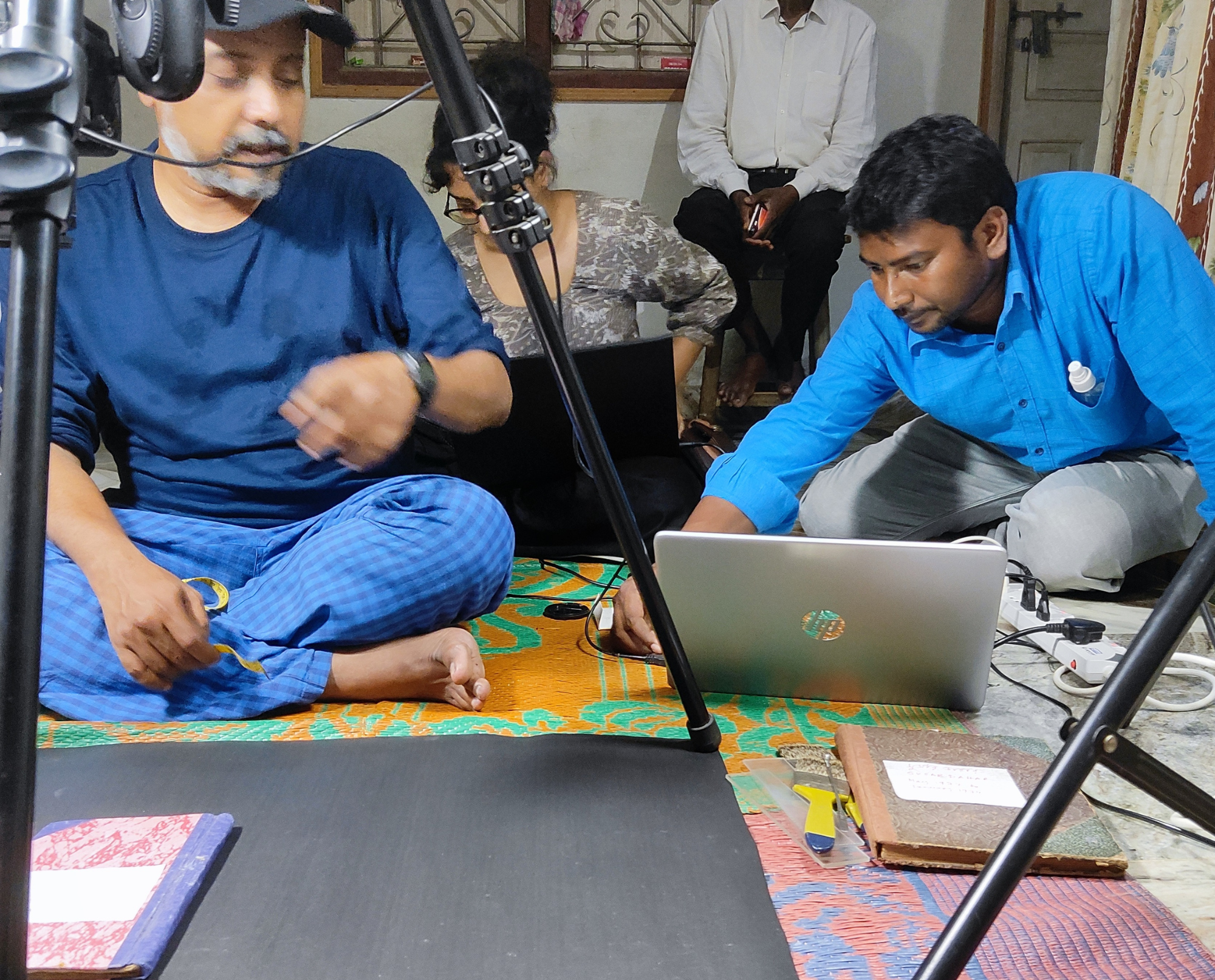
Santali cultural heritage has been largely transmitted orally through generations. However, they were put in print when a series of periodicals were initiated by Christian missionaries in eastern India during the early 19th century. The project has digitalized books and periodicals published between 1890 and 1975, representing a vast body of first-hand knowledge and information about Santali cultural heritage. The project has also located endangered manuscripts of Sadhu Ramchand Murmu (1897-1954) and Pandit Raghunath Murmu (1905-1982), who have had widespread contributions in invention of the Santali OlChiki script.
The periodicals are written in the Santali language, using Bengali and Roman script with diacritics. Many songs contain early translations of Hymns from English to Santali having non standard spellings and dialects. The vocabulary and grammar of the periodicals are multi-layered, using technical terms from Christianity, Hindi and Bengali and incorporating them in Santali texts and literature.
The materials are located with collectors at Banduan, Purulia District and Berhampore, Murshidabad District. Most of the material is acutely vulnerable। Many pages are torn with wrinkled edges and have been found to be brittle. The cause of decay stems from the fact that these materials were repeatedly dislocated as the private collectors had to flee Naxalite-Maoist insurgency during 2008-2010. As a result, the materials have suffered prolonged exposure to the elements resulting in wear and tear. The materials are a significant resource for the study of oral literature, the transformation from oral to written cultures, and the interconnection between indigenous religion and Christianity. The periodicals have immense potential to provide primary research material for Santali scholars researching linguistics, folklore, folk songs, and specific cultural forms such as riddles which are threatened in this era of globalization.
Digitizing the materials will help to generate a subaltern narrative of the contemporary political scenario which resulted to forced migration of the indigenous community residing in four states of India, namely Jharkhand, Odisha, Assam and West Bengal. The effects of the historic SantalHul of 1855 (the great Santal rebellion of 1855) on literature and oral history of the community are also embedded in the literary material proposed for digitisation.
Given the rising COVID situation, online training program was arranged, namely ‘Training Building Digital Archives: An Online Training Programme’ between October 25, 2021 to October 29, 2021 (21 hours). The inaugural address was given by Professor Samantak Das, Pro-Vice Chancellor and Director, School of Cultural Texts and Records, Jadavpur University followed by Preliminary Remarks on the Training Program by the principal investigator, Dr. Rahi Soren. Speakers of national and international reputes were invited, namely
- Sukanta Chaudhuri (Professor Emeritus,Jadavpur University)
- Spandana Bhowmik (Wipro Archives)
- Abhijit Gupta (Professor and Director Jadavpur University Press and Joint Director, School of Cultural Texts and Records)
- Mahadev Hansda (Editor, Tetre)
- Sarada Kisku (Santali Author)
- Nishaant Choksi (IIT, Gandhinagar)
- Tone Bleie (Professor, University of Tromsø)
- Debapriya Basu (IIT, Guwahati)
- Dablu Soren (Teacher, Murshidabad).
Outcomes
The records copied by this project have been catalogued as:
- EAP1300/1 Private collection of Dablu Soren (1931-1986)
- EAP1300/2 Private collection of Raban Chandra Baskey (1968-1982)
- EAP1300/3 Private collection of Sushil Baskey (1968-1973)
- EAP1300/4 Private collection of Mahadeb Hansda (1958-1982)
- EAP1300/5 Private collection of Purna Chandra Soren (1940-1984)

Rahi Soren
Pricncipal Investigator

Amritesh Biswas
Onsite digitisation

Shrutakirti Dutta
Listing, data management

Sitaram Baskey
Survey of Santali manuscript
Rashtriya Uchchatar Shiksha Abhiyan 2.0
Resource Mapping the Early Recordings of Traditional Santali Songs
Song is the remembrance of the songs sung. As remembered experience, song is the result, not deliberate memorization, but only of recollection…it is the conscious, phenomenalized aspect of the oral compositional process. Songs can be identified in traditional compositions as a plan of themes, or a skeleton of narrative, or a basic ‘idea’; but more simply, song is what the singer remembers as the truth. (Peabody, pp 216)
Santali, an Austro-Asiatic language , belonging to the Munda family of languages, was mostly considered as ‘oral’ language and was not tied to an alphabetic or syllabic script until the mid-nineteenth century. It is spoken by approximately 7.5 million speakers throughout eastern India and sporadically in Nepal and Bangladesh
Santali cultural heritage has been largely transmitted orally through generations. Santali songs have existed not only within a definable space or time, but rather at moments of disjuncture – in between regions, amid moments of transition and transformation, and at the border of ethnic, religious, and social boundaries.
Public archives of Santali music are scarce and scattered and are not available to researchers of music, musicology or cultural ecology. In an attempt to achieve the same, we at Jadavpur University, Kolkata took upon a project under Rashtriya Uchchatar Shiksha Abhiyan (RUSA 2.0) entitled Resource Mapping the Early Recordings of Traditional Santali Songs. The objective of the research was to locate Santali audio recordings held by any public archives as well as private collectors. To make an exhaustive digital catalogue of all the holdings along with full bibliographical descriptions and title-page transcriptions. A systematic study of public holdings and the extent of the collections have been catalogued with extensive metadata of 904 songs dating from 1914 to 2005. These were collected from All India Radio Stations, Kolkata, Chaibasa, Ranchi, Bhagalpur and Baripada and private collections which consists of largely of Baha sereń, Do̠ń sereń, Dansǎe, Chạṭiyạr, Lagṛě̠, Matwar, Pata, Sǒhǎṛe, Ḍahar, Ḍaṇṭa, Karam, Sakrat, Luh́ri and a few unspecified songs.
The materials are a significant resource of oral literature, the transformation from oral to written cultures, the interconnection among indigenous religions and Christianity. They have immense potential to provide primary research material for research to Santali scholars researching linguistics, folklore, folk songs, and specific cultural forms such as riddles which are threatened in this era of globalization. They also reflect the voices of the minority in the digital era and help generate a subaltern narrative of the contemporary political scenario which resulted in forced migration of the indigenous community. The effect of the historic Santal Hul of 1855 (the great Santal rebellion of 1855) on literature and oral history of the community are also embedded in the songs. This paper attempts to explore questions as to what is the true potential of such community archives and how the indigenous community perceives it. It will also investigate the ways in which assemblages of technologies, political institutions, and practises of exchange have rendered cultural evolution of Santali songs within the community.
The earliest recordings found were the field recordings from the Linguistic survey of India from 1914. The Survey was first proposed by George Abraham Grierson, a member of the Indian Civil Service and a linguist who attended the Seventh International Oriental Congress held at Vienna in September 1886
Three discs have been found with recordings in Santali,these were catalogued as: a special text in Santali: ‘man, spoken voice’ is recorded, the second disc was marked as ‘dal sering, dassi sering in Santali’ and catalogued as ‘Santali Chant songs’ whereas, another disc contains recording of ‘Parable of the prodigal son’.
The following two songs that had been recorded are:
Song I
Muc’ko Muc’kodo ko
Dogod’ Dogod’ do’
Mana chapa-kiya baṛe latar
Dar reko dogod’ dogod do’
Mana chapa-kiya bare latar
Ḍạr reko dogod’ dogod do’
Ne tora nete tora
Murum pańja
Ne tora nete tora
Sosam pańja
English translation of Song I
Oh! Muc’ko Muc’kodo
Girls dancing in rhythm
Near chapa-kiya; just below the Banyan tree
are dancing in rhythm
Near chapa-kiya; below the brancing Banyan tree
are dancing in rhythm
Look out! Look out!
For the Nilgai
Look out! Look out!
For the cattle